
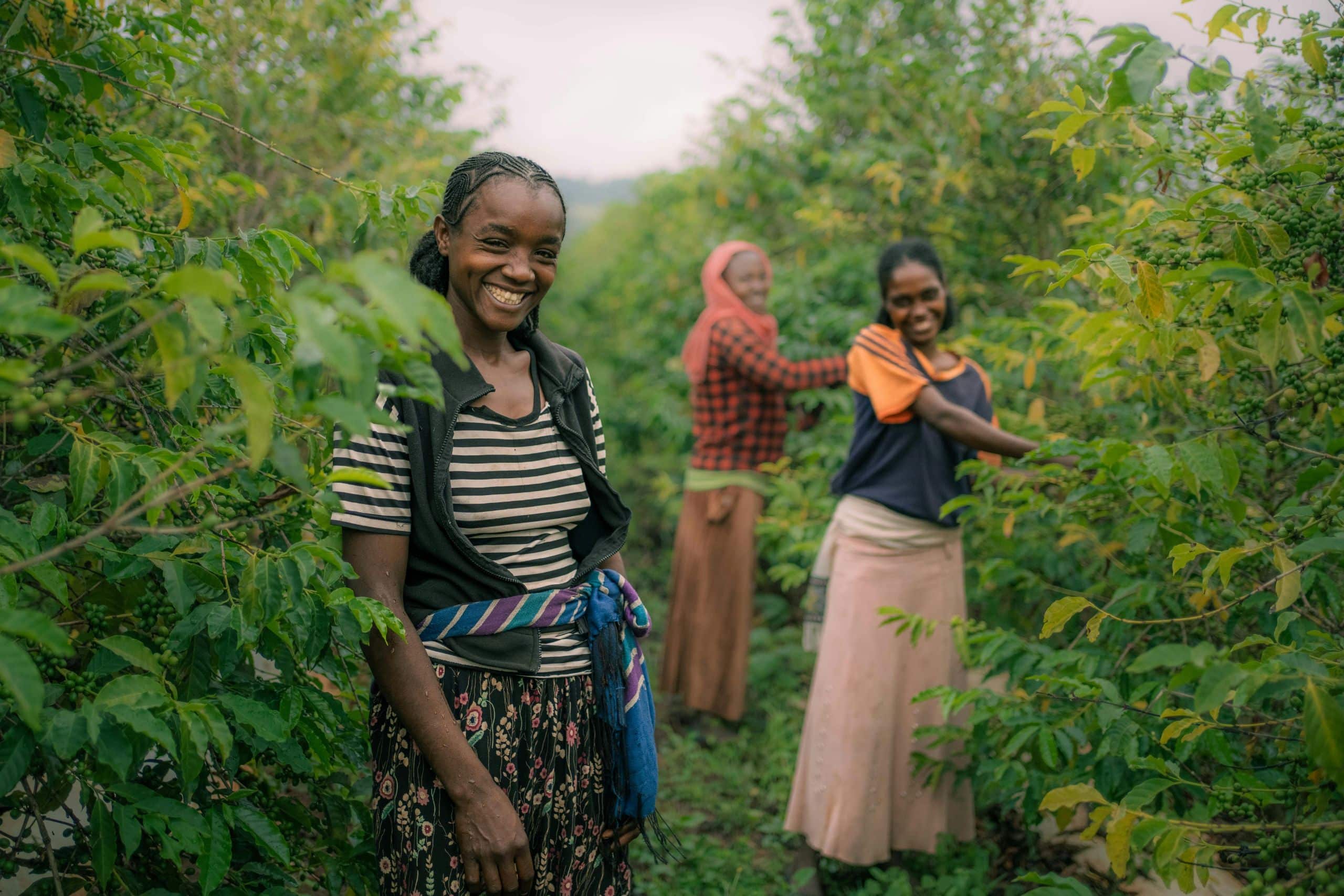
Behind every cup of coffee is a story. For centuries, women have been the quiet force moving the industry forward: innovating, farming, organizing, and leading. Yet all too often, their names are pushed to the margins, overshadowed by structures that make it more difficult for women, especially in the Global South, to secure land ownership, capital, agricultural resources, and market access.
Today, we’re uplifting five women, past and present, whose work has helped reshape the coffee world. Their stories reflect ingenuity and a vision for a more equitable future.
Melitta Bentz: Inventor Who Changed How the World Brews

In 1908, frustrated by bitter, over-extracted percolator coffee, Melitta Bentz punched holes into a brass pot and lined it with blotting paper borrowed from her son’s school notebook. Her improvised design created the world’s first paper coffee filter — a simple invention that rewrote coffee culture.
Bentz patented her design and founded the Melitta company, which grew into one of the most influential brands in coffee history and helped popularize drip-brew culture in homes and cafés around the world. More than a technological innovation, Bentz’s filter democratized good coffee. By making brewing accessible and consistent, she shifted the practice away from restaurants and elites and into everyday households, redefining coffee as something anyone could enjoy.
Erna Knutsen — The Godmother of Specialty Coffee
Erna Knutsen helped spark the worldwide movement that came to be known as specialty coffee: the art of careful cultivation, processing, roasting, and brewing. Her rise was an underdog story: she entered the trade as a secretary at B.C. Ireland, slowly working her way into leadership and championing the small-lot roasters ignored by big traders. She recognized the value of “broken lots” (beans that didn’t fit commodity systems yet offered exceptional flavor) and connected them to roasters who prized quality and provenance.
To communicate effectively with these roasters, Knutsen insisted on cupping the coffees herself. But at the time, women were not welcome in these spaces. Some men at her company told colleague Bert Fulmer, using openly offensive language, that they would quit if she were permitted at the cupping table. So she cupped at her desk instead. Her first full container, a Sumatra Mandheling, sold out within a month.
In 1973, she finally earned a seat at the table. That same year, she coined the term “specialty coffee,” naming the movement she helped ignite.
Epiphanie Mukashyaka — Rebuilding Rwanda’s Coffee, One Community at a Time

Before 1994, Rwandan women could not inherit land or easily run businesses. After the genocide, roughly 70% of the surviving population was female, yet many women, including widows like Epiphanie Mukashyaka, were left without legal standing or income.
After losing her husband during the genocide, Mukashyaka fought to secure control of her family’s land and took a major leap: she built Nyarusiza, the first woman-owned private coffee washing station in Rwanda. Supported by loans and grants from USAID and PEARL, she trained farmers, improved processing standards, and pushed for quality that would command better prices. Her coffees soon attracted international recognition and helped elevate Rwanda’s reputation in specialty markets.
Nyarusiza later became the foundation for Bufcoffee, partnering with thousands of smallholder farmers, many of them women. Mukashyaka expanded to a second washing station, Remera, and earned multiple Cup of Excellence awards. By 2016, Bufcoffee had more than 4,000 shareholders and exported premium coffee abroad; in 2019, she received Rwanda’s Woman Entrepreneur of the Year award.
Mukashyaka’s work was deeply communal: she created jobs for widows, built training and education programs, and helped restore economic stability. Her resilience and vision reshaped Rwanda’s coffee sector and opened new horizons for women across East Africa.
Aida Batlle — Pushing Specialty Coffee to New Heights
In El Salvador’s Santa Ana region, fifth-generation producer Aida Batlle transformed her family’s farms into a center for cutting-edge cultivation and processing. In 2003, she entered her first Cup of Excellence competition and won, and her coffees have since become some of the most sought-after in the world.
Batlle is known for pursuing excellence at every stage: from meticulous harvest oversight to experimental fermentations and processing techniques. Her approach helped inspire a deeper focus on transparency, creativity, and producer-roaster collaboration across the industry. She also helped popularize cascara (the dried husk of the coffee fruit). Cascara from her high-elevation farm Kilimanjaro has inspired cafes worldwide to adopt cascara beverages.
In 2009, she launched the Aida Batlle Selection (ABS) program to identify and distribute exceptional coffees. Now expanded globally through a partnership with ECOM, ABS continues to certify and support farms in El Salvador, Mexico, and beyond.
Despite her global reach, Batlle remains hands-on, pruning trees with her machete and sorting cherries alongside her workers. Her commitment to experimentation, quality, and community continues to shape the future of specialty coffee.
Le Hoang Diep Thao — Championing Vietnamese Coffee on a Global Stage

In Vietnam’s Central Highlands, Le Hoang Diep Thao recognized that coffee could be a powerful cultural and economic force. While working at the Gia Lai Post Office’s 108 information hotline, she noticed that most inquiries were about coffee.
She co-founded Trung Nguyên, which rapidly reshaped Vietnam’s coffee economy. Within two years, the brand was connected to more than 1,000 cafés, helping launch what many call the country’s third wave of coffee and transforming café culture into an accessible everyday pastime. In 2016, Thao launched King Coffee, introduced internationally through Paris By Night to reach the Vietnamese diaspora. A year later, she opened a new factory to expand instant production; today, King Coffee exports worldwide and continues to elevate Vietnamese specialty coffee.
Thao dedicates her platform to empowering women and farmers. Through the Women Can Do program, King Coffee has supported more than 100,000 aspiring female franchise owners with training and business support. Her Happy Farmers initiative invests in producer communities through education, new technology, and stable purchasing.
Growing Together
Women in coffee have always been innovators, farmers, scientists, entrepreneurs, and organizers, even when the world refused to recognize their work or allow them to lead. Their stories remind us how much stronger communities become when people are given the space to thrive.
At Arboretum Coffee, we’re proud to honor the long legacy of women who grew (and continue to grow) the industry we love. Just as these leaders cultivated opportunity in their communities, we’re working to create opportunity here in ours by supporting refugees and immigrants through meaningful employment and community connection.
Learn more about how our non profit coffee shop supports equitable access to work and community for newcomers.
When we plant seeds of opportunity for women, refugees, and immigrants, we all grow.
Leave a Reply